Home / Ceylon Cinnamon Guide
Cinnamomum verum · Sri Lanka
Ceylon Cinnamon:
the complete guide to true cinnamon.
From an evergreen Sri Lankan plant to a delicate, multilayered quill—discover its history, protected origin, craft, oils and the facts that separate it from cassia.
01 · The essential definition
What exactly is
Ceylon cinnamon?
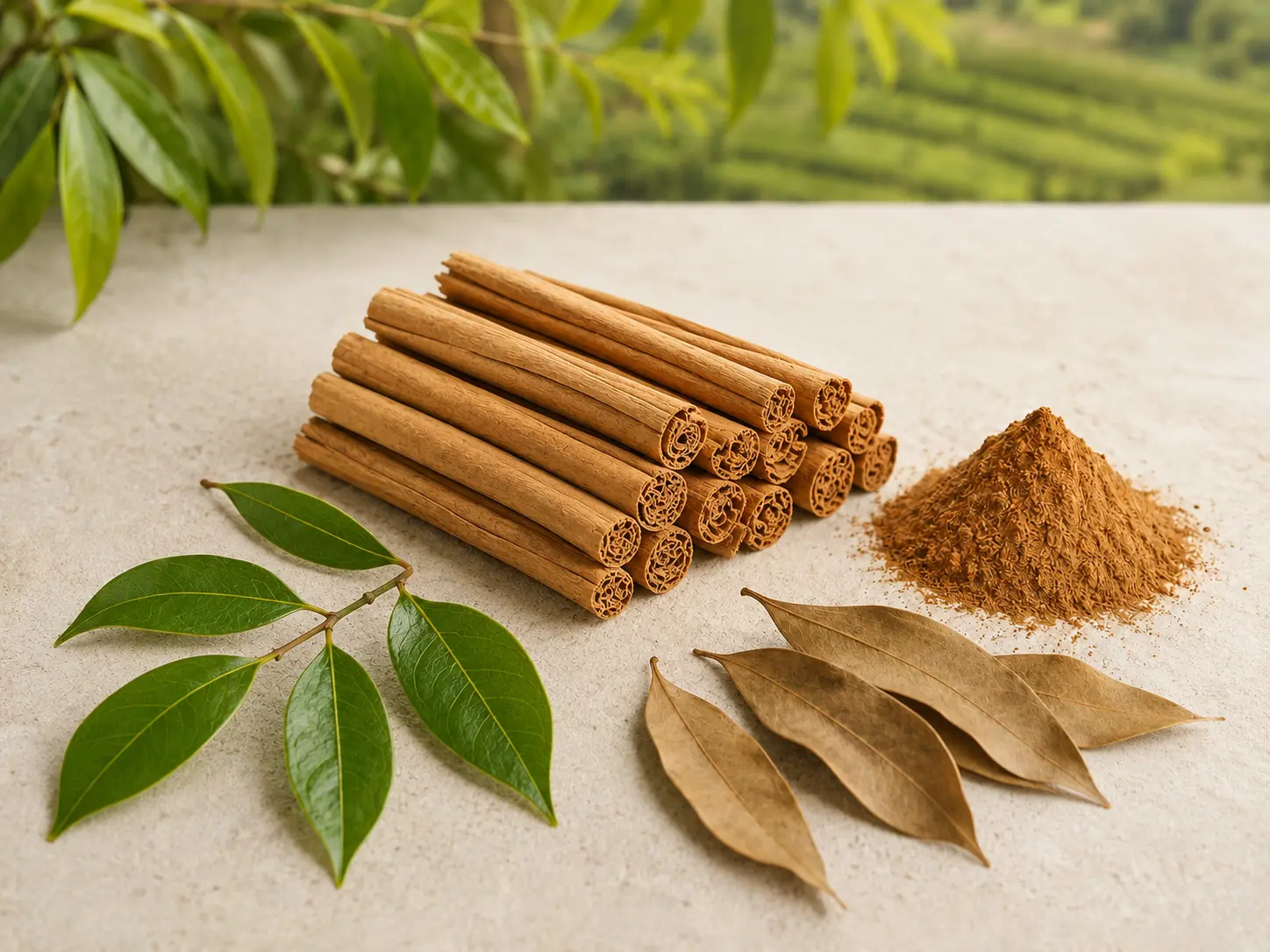
Ceylon cinnamon is the aromatic inner bark and related products of Cinnamomum verum, an evergreen tree native to Sri Lanka. The older botanical name Cinnamomum zeylanicum refers to the same species.
“Cinnamon” is also used as a broad market name for spices from several related species. That is why the word on the front of a pack does not, by itself, prove that the contents are Ceylon cinnamon.
02 · A history older than modern trade
A famous spice,
with a complicated record.
Ancient texts prove that aromatic substances called cinnamon were known and valued. They do not always prove which modern species—or which country of origin—was involved.
- Ancient world
Egypt and early long-distance trade
Cinnamon was valued in the ancient world, and Kew records its use in Egyptian embalming. Because ancient names and trade routes were imprecise, historians cannot safely assign every early “cinnamon” reference specifically to Sri Lankan C. verum.
- Biblical texts
Cinnamon as a precious aromatic
Cinnamon appears in Exodus 30:23, Proverbs 7:17, Song of Songs 4:14 and Revelation 18:13—in sacred oil, perfume, garden imagery and trade. These passages establish its cultural value, not a modern botanical or geographical certification.
- Late 10th century
A traceable reference to Ceylon
Sri Lanka’s Department of Cinnamon Development identifies the late-tenth-century Aja’ib al-Hind by Buzurg ibn Shahriyar as the first reference specifically connecting cinnamon with Ceylon.
- 13th century
Sri Lanka’s reputation was recorded
The Department also reports that Portuguese historian Diogo do Couto described the island as known for fine and abundant cinnamon during the reign of Parakramabahu II (1236–1270).
- 16th–18th centuries
European powers fought for control
Portuguese and then Dutch colonial systems controlled the trade. The Dutch moved from wild collection toward systematic cultivation; the British took control of Ceylon in 1796 and continued the commercial industry.
- 2 February 2022
Ceylon Cinnamon became an EU PGI
European Commission Regulation (EU) 2022/144 entered “Ceylon cinnamon” in the EU register of protected geographical indications—Sri Lanka’s first GI registered in the European Union.
03 · Protected geographical indication
What does the
GI recognition mean?
A geographical indication is an intellectual-property right used for a product whose quality, reputation or other characteristic is linked to a particular place.
The EU PGI protects the name “Ceylon cinnamon” for qualifying products connected to Sri Lanka and the specified local production know-how. The registered categories cover cut quills, powder, leaf oil and bark oil.
Important: GI recognition protects a collective origin and specification. A producer cannot simply print the PGI mark because the cinnamon grew in Sri Lanka. Use of the mark requires the relevant authorisation and compliance controls.
Read the official EU regulation →04 · Ceylon cinnamon and cassia
Similar family.
Different spices.
Cassia is not counterfeit by definition. It becomes deceptive when a seller labels it—or a blend containing it—as Ceylon cinnamon.
| Feature | Ceylon cinnamon | Common cassia types |
|---|---|---|
| Plant | Cinnamomum verum (syn. C. zeylanicum) | Several species, commonly C. cassia, C. burmannii or C. loureiroi |
| Origin association | Native to Sri Lanka; the protected Ceylon Cinnamon PGI is tied to Sri Lankan origin and know-how | Associated mainly with China, Indonesia and Vietnam, depending on species |
| Quill structure | Many thin inner-bark layers telescoped together | Usually one thick, hard scroll or a few thick layers |
| Colour and texture | Pale tan to light brown; fine, papery and fragile | Generally darker reddish brown; thick, dense and hard |
| Flavour | Delicate, sweet, floral and citrus-like | Stronger, hotter and more forceful |
| Coumarin | Naturally low | Usually much higher; frequent heavy users are advised to choose low-coumarin Ceylon cinnamon |
| Best identification | Species, Sri Lankan origin, layered quill, traceable supplier and—where claimed—authorised PGI mark | Species and declared country of origin |
Powder needs more than a visual check
Once bark is ground, colour and aroma alone are not dependable proof. Look for the botanical species, declared origin, traceability and—in higher-risk or commercial purchases—appropriate analytical verification. A PGI logo should be verifiable, not merely decorative.
Open the detailed Ceylon cinnamon vs cassia identification guide →
05 · Understanding the premium
Why informed buyers
pay more for it.
Refined flavour
A delicate, sweet and complex profile suits recipes where cinnamon should contribute aroma without dominating every other ingredient.
Skilled handwork
The fine inner bark is removed, handled and assembled by trained peelers. A quill is built from multiple thin pieces rather than rolled as one thick sheet.
Lower coumarin
Ceylon cinnamon naturally contains far less coumarin than common cassia. Germany’s BfR recommends it for people who frequently use large amounts of cinnamon.
Origin and traceability
Sri Lankan origin, traditional know-how, careful grading and—in authorised supply chains—PGI control add value that anonymous bulk “cinnamon” cannot provide.
“Superior” should not mean a miracle food or the only useful cinnamon. It means Ceylon cinnamon offers a distinct combination of origin, sensory quality, fine quill structure, craftsmanship and low coumarin for buyers who value those characteristics.
06 · From young plant to harvest
Cinnamon is managed
as a renewing bush.
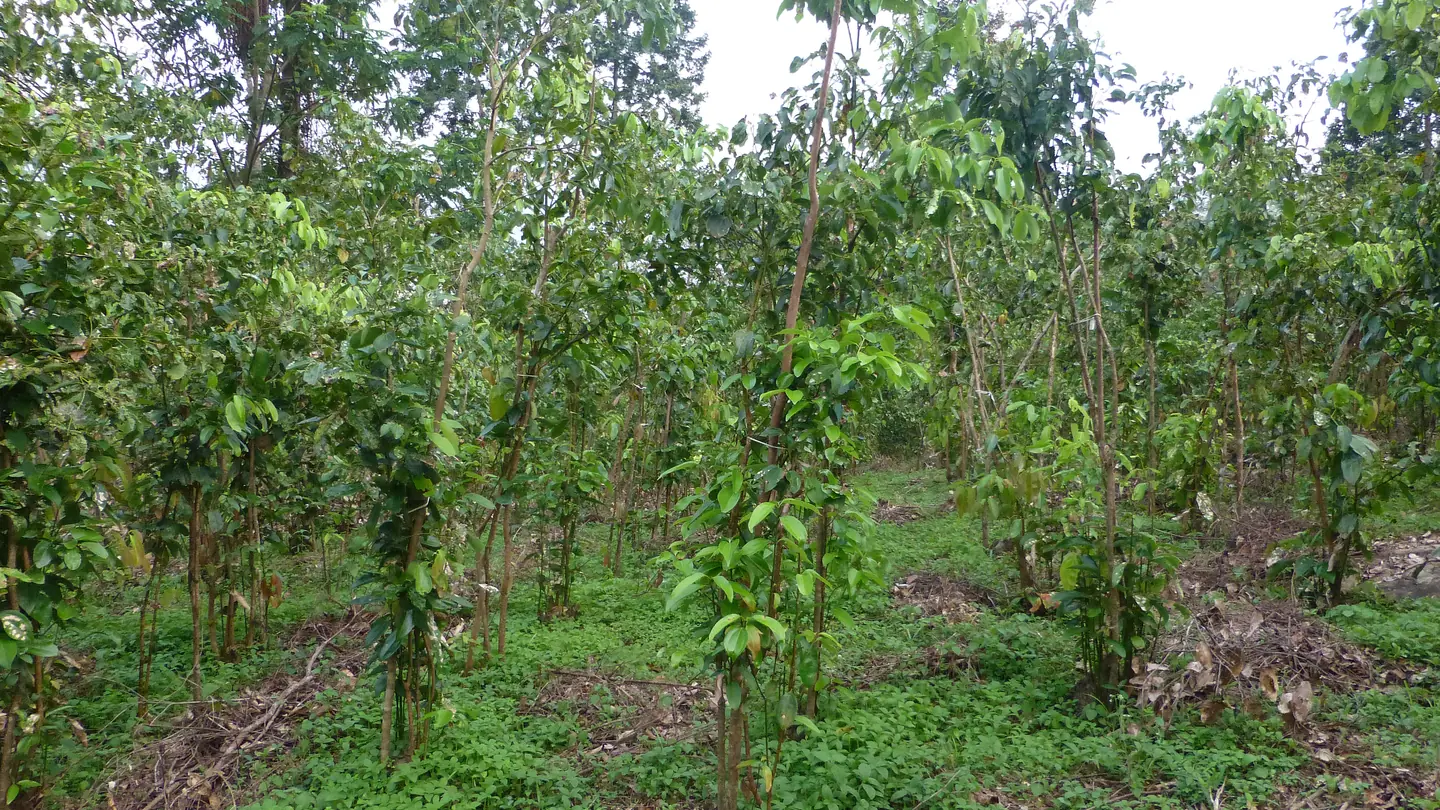
Left alone, Cinnamomum verum can grow as an evergreen tree. Commercial bark production manages it as a multi-stem bush through coppicing, which encourages suitable new shoots.
- 1Propagation
Healthy seedlings or vegetatively propagated plants are established at the start of a suitable rainy season.
- 2Field establishment
Young copper-red leaves mature to green as the plant develops and branches under full light.
- 3Bush formation
Training and coppicing create several straight stems rather than one large permanent trunk.
- 4First harvest
Under suitable management, harvesting can begin at about three years, when selected stems have reached the right maturity and peelability.
- 5Regrowth
The stump remains alive and sends up new shoots, allowing repeated harvest cycles instead of replanting after every cut.
07 · Making a Ceylon cinnamon quill
From living stem
to layered quill.
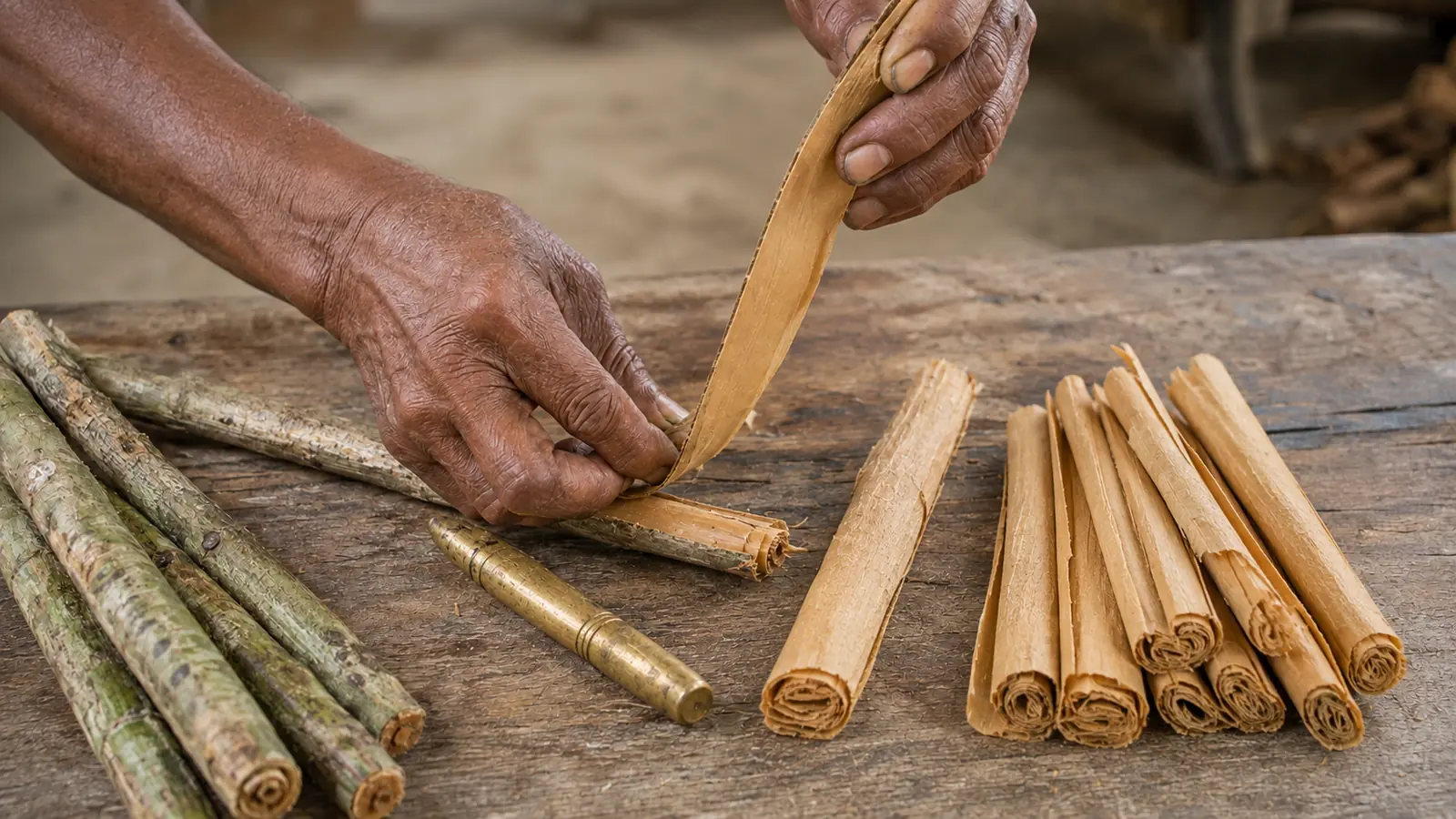
- 1Select and cut
Mature, peelable stems are chosen and cut carefully to support regrowth.
- 2Trim and scrape
Leaves and side shoots are removed; the corky outer bark is scraped away.
- 3Rub and loosen
A smooth brass rod is traditionally used to rub the stem and help release the inner bark.
- 4Slit and peel
Longitudinal cuts allow thin inner-bark sections to be lifted from the wood.
- 5Build the quill
Sections are overlapped and telescoped; smaller bark pieces fill the centre to create the characteristic layered structure.
- 6Dry, trim and grade
The assembled quill dries as the bark curls and firms. It is then inspected, graded and cut for the intended market.
08 · Cinnamon essential oils
One plant.
Two very different oils.
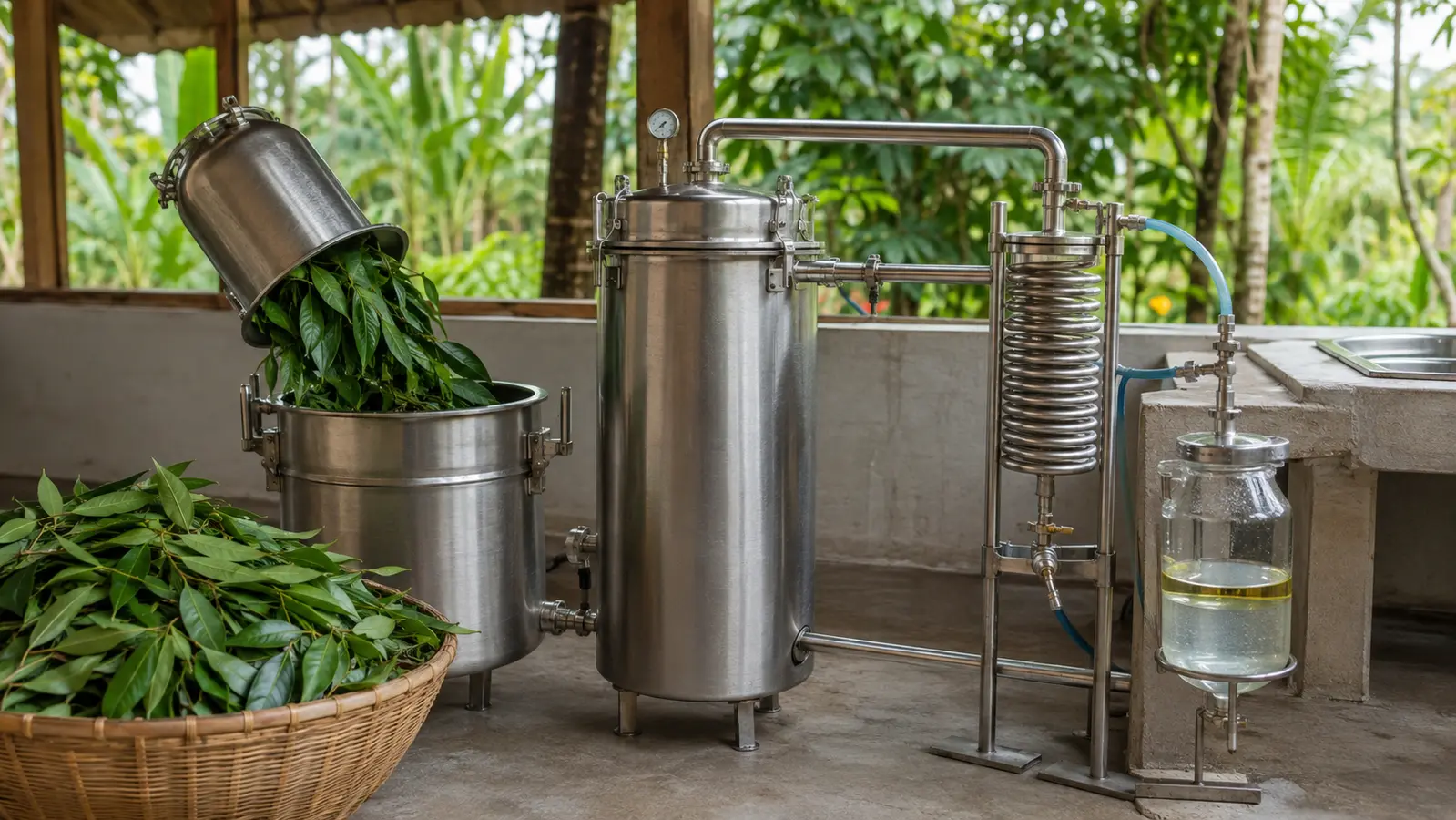
Steam or hydro-distillation carries volatile aromatic compounds from plant material into vapour. After condensation, the essential oil is separated from the water phase.
Leaf oil
Produced mainly from leaves and small leafy material. Its characteristic profile is generally rich in eugenol, giving it a clove-like aromatic character.
Bark oil
Produced from bark material. Its characteristic profile is generally rich in cinnamaldehyde, giving the familiar warm cinnamon-bark aroma.
09 · How it is used
Different forms,
different purposes.
Quills and cut quills
Slow infusions, rice, curries, beverages, desserts, preserves and presentation-led culinary use.
Powder
Baking, spice blends, drinks and recipes needing even dispersion. Ground identity requires stronger traceability than whole quills.
Leaves
Fresh cinnamon leaves have culinary uses in Sri Lankan cooking and can also provide raw material for distillation.
Leaf and bark oils
Used as specialised flavour, fragrance and industrial ingredients under appropriate formulation, safety and regulatory controls.
10 · Frequently asked questions
Clear answers
without the folklore.
Is Ceylon cinnamon the same as true cinnamon?
Yes. True cinnamon commonly means Cinnamomum verum, also known by the botanical synonym Cinnamomum zeylanicum. Ceylon cinnamon is the traditional commercial name associated with Sri Lanka.
Is cassia fake cinnamon?
No. Cassia is a genuine spice produced from other Cinnamomum species. The problem is not cassia itself; it is mislabelling cassia, or a blend containing cassia, as Ceylon cinnamon.
Can ground Ceylon cinnamon be identified by sight?
Not reliably. Powder removes the visible quill structure. Check the botanical species, Sri Lankan origin, producer traceability, packaging claims and supporting testing or certification where relevant.
Does every cinnamon product from Sri Lanka carry the EU PGI mark?
No. The protected name and mark are governed by a specification. The PGI mark may be used only by authorised participants whose qualifying Ceylon cinnamon products meet the requirements.
Why does Ceylon cinnamon cost more than cassia?
Its price reflects limited origin, skilled labour, the time-intensive quill-making method, careful grading, delicate handling, traceability and demand for its refined flavour and naturally low coumarin.
Are cinnamon leaf oil and bark oil the same?
No. They come from different plant material and have different chemical profiles and aromas. Leaf oil is generally eugenol-rich, while bark oil is generally cinnamaldehyde-rich.
Sources and evidence
Where these facts
come from.
Historical identifications are stated cautiously where ancient terminology cannot prove a modern botanical species or place of origin.
From knowledge to a clear enquiry
Looking for traceable
Ceylon cinnamon?
Tell us the required form, approximate quantity, destination and expected timing. Availability, preparation, packaging and documentation are confirmed before commitment.