
Home / Ceylon Cinnamon Guide / How It Is Made
Plant · harvest · peel · quill
How Ceylon cinnamon
is made.
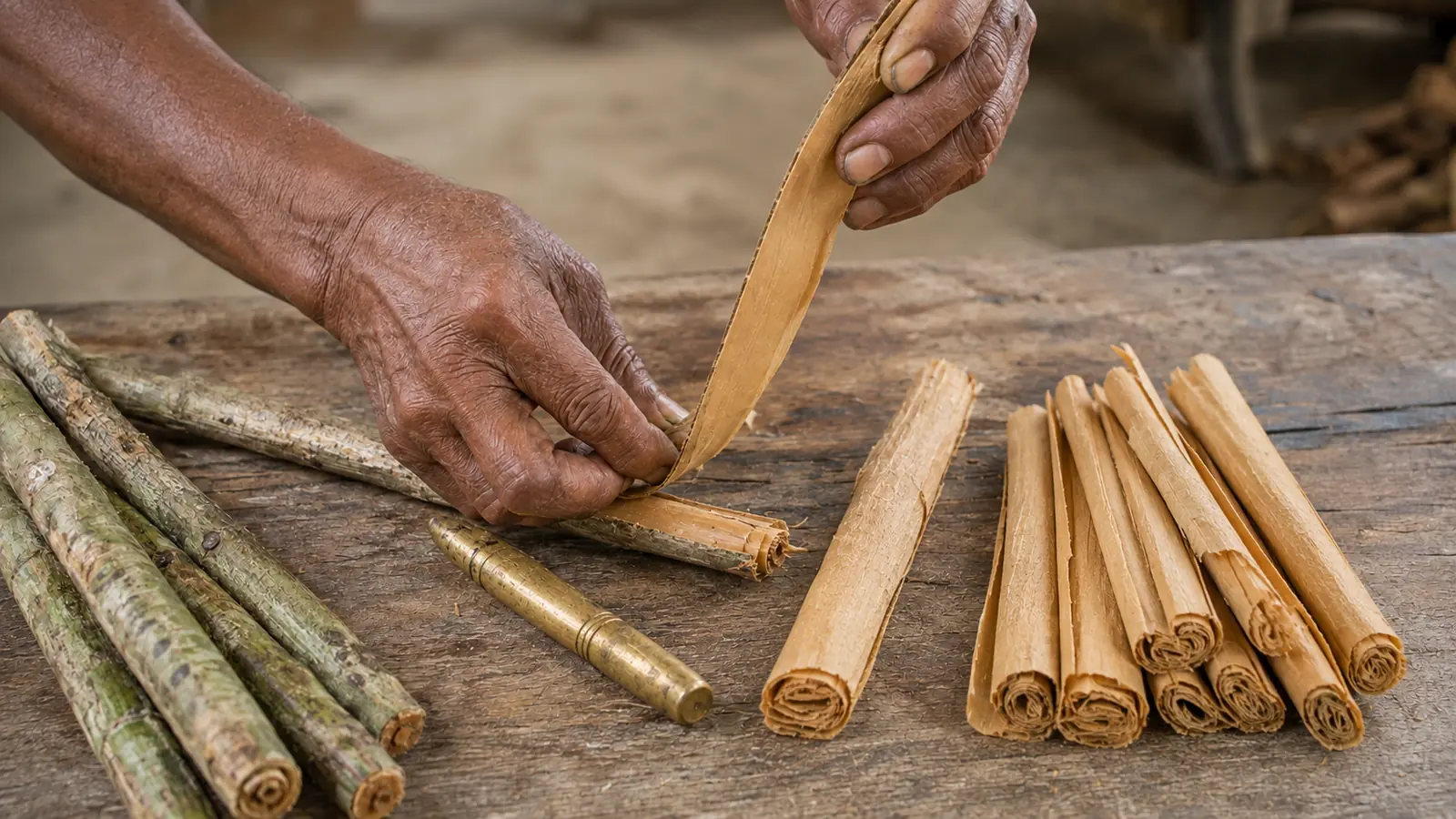
True Ceylon cinnamon is not a thick piece of bark rolled once. It is a skilled Sri Lankan craft that builds a quill from multiple thin sections of inner bark.
01 · The living plant
A tree managed
as a renewing bush.
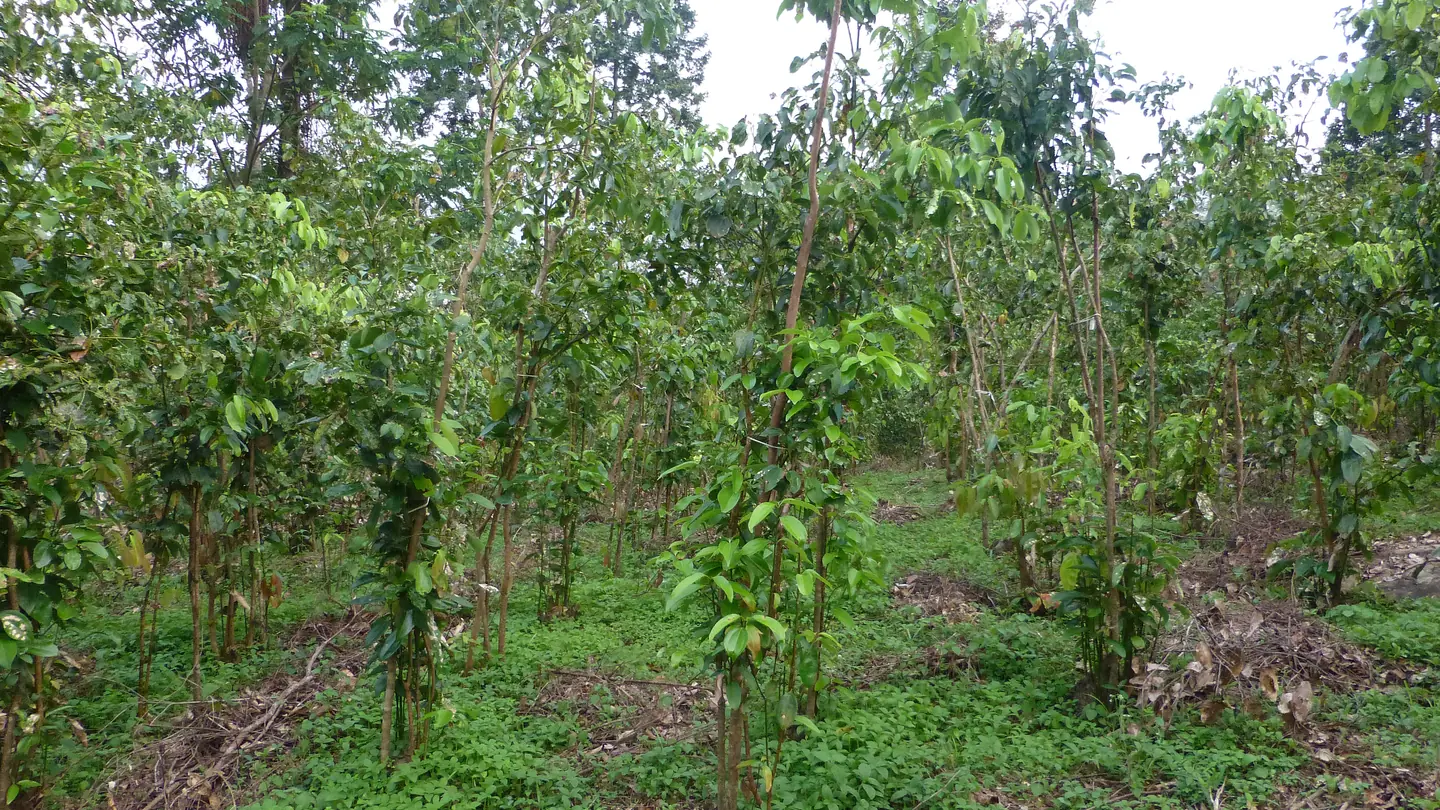
Cinnamomum verum is an evergreen tree native to Sri Lanka. For commercial bark production, it is coppiced and managed as a multi-stem bush.
Cutting selected stems does not end the plant. The living stump sends up new shoots, allowing repeated harvest cycles when the bush is maintained correctly.
02 · Selecting and harvesting stems
Timing matters
because bark must peel.
Sri Lanka’s Department of Cinnamon Development advises harvesting when new leaves have matured to green and the bark separates more readily. Stems with new leaves, flowers or fruits can be harder to peel.
- Choose
Select suitable stems
Stem maturity, straightness, health and peelability influence the quality and form of bark available for processing.
- Cut
Make a clean angled cut
Official guidance describes a sharp 45-degree cut roughly 1½–2 inches above ground level, angled toward the bush to encourage outward regrowth.
- Trim
Remove leaves and branches
Leaves, immature tips and side branches are removed before stems enter the peeling shed or processing area.
- Keep clean
Protect the raw material
Stems and peeled bark must be kept away from soil and avoidable contamination throughout processing.
03 · Making the quill
Six skilled
processing stages.
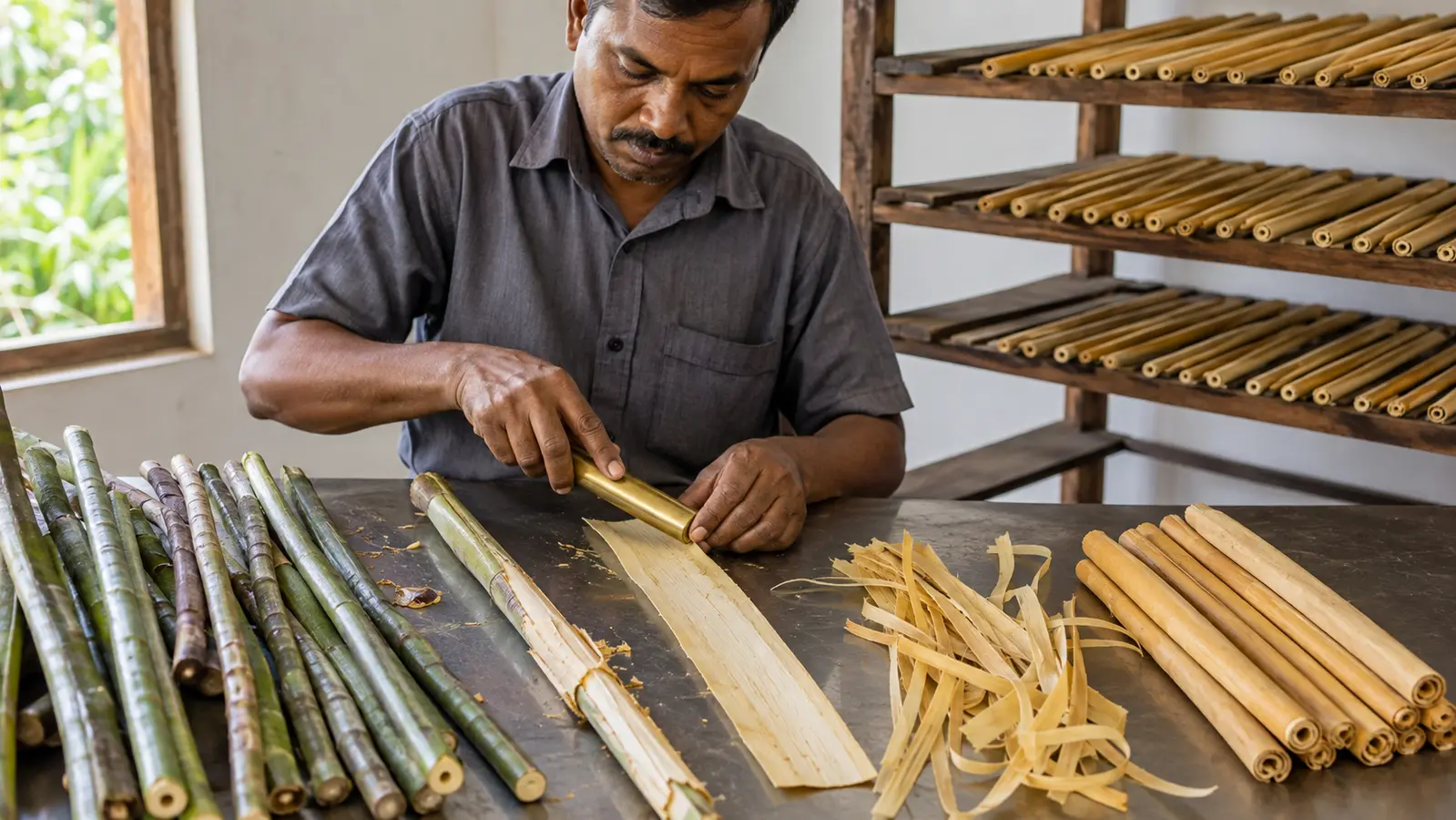
- 1Scrape the outer bark
The brown corky outer layer, locally called kurutta or sumbula, is carefully removed from the stem.
- 2Rub the stem
A smooth brass rod is traditionally used to rub the scraped stem and help loosen the inner bark from the wood.
- 3Mark the bark
Special knives make longitudinal and cross cuts according to the bark width required for the intended grade.
- 4Lift the inner bark
Thin sections are eased away from the wood. Narrower pieces that cannot form a full outer sheet are retained as filling material.
- 5Allow initial curling
The peeled bark is briefly shade-dried until it reaches the right curling condition for assembly.
- 6Assemble the quill
Outer sheets are overlapped and telescoped together, then filled with smaller bark pieces to create a long, filled, multilayered quill.
04 · Drying and grading
The quill must
dry evenly.
Completed quills are shade-dried on clean strings, racks or nets. Official Sri Lankan guidance describes approximately four to seven days of drying until moisture reaches 14% or below.
After drying, quills are assessed using criteria that include diameter, the number of quills required to make one kilogram and the percentage of surface “foxing.” Whole quills may then be cut to the length required for a market.
05 · Cinnamon oil production
Leaves and bark
produce different oils.
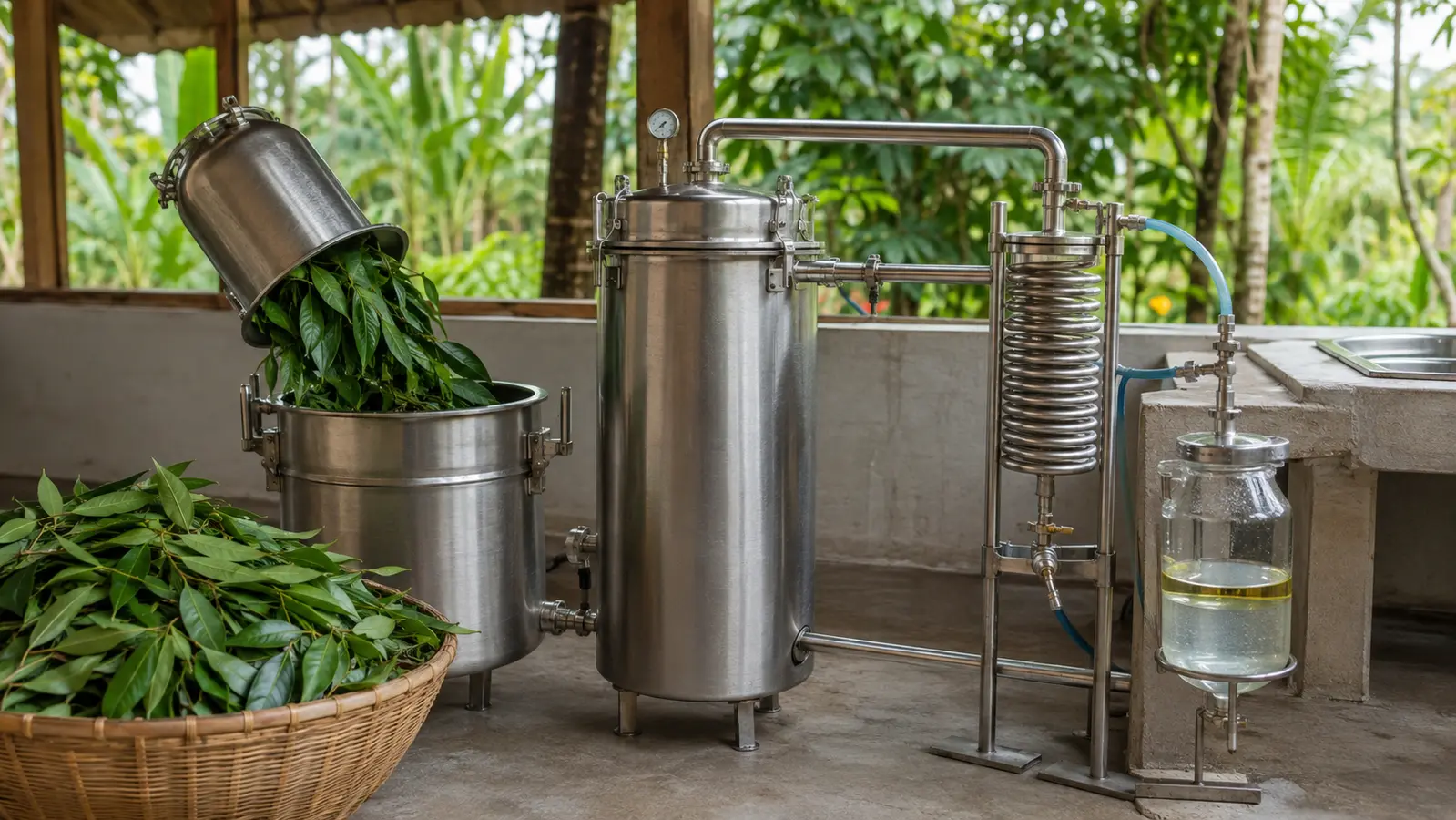
Steam or hydro-distillation carries volatile compounds from the plant material into vapour. After condensation, the essential oil is separated from the water phase.
Leaf oil
Produced mainly from leaves and small leafy material. Its characteristic profile is generally rich in eugenol.
Bark oil
Produced from bark material. Its characteristic profile is generally rich in cinnamaldehyde.
06 · Frequently asked questions
Process questions,
answered clearly.
Which part of the cinnamon plant becomes a quill?
The quill is made from the thin inner bark of suitable Cinnamomum verum stems. The corky outer bark is scraped away before the inner bark is loosened and peeled.
Why does a Ceylon cinnamon quill contain many layers?
Peeled bark sections are overlapped and telescoped together, while smaller pieces fill the centre. This creates the fine, filled, multilayered structure associated with true Ceylon cinnamon.
How long are traditional whole Ceylon cinnamon quills?
Sri Lanka's Department of Cinnamon Development describes traditional whole quills of 42 inches, with 21-inch quills also prepared. Cut quills are shortened to the buyer's intended length after grading.
Are cinnamon bark oil and cinnamon leaf oil the same?
No. They are distilled from different plant materials and have different characteristic chemical and aroma profiles. Leaf oil is generally eugenol-rich, while bark oil is generally cinnamaldehyde-rich.
Sources and review
Based on official
Sri Lankan guidance.
Prepared and maintained by Ambokka Plantation, a directly managed plantation in Pallepola, Matale. Last reviewed: 24 August 2026.
Understand the finished product
Learn why Ceylon quills
do not look like cassia.
Compare species, origin, colour, texture, flavour, coumarin and the visible cross-section of whole cinnamon sticks.